
Creating a dictionary
A dictionary is written in a spreadsheet: a few CSV files arranged in folders, plus course notes in Markdown. You import
them as they are, or bundled into a .parrot file to share.
The complete example
This page follows a small, real dictionary, “At the café”: French for English speakers, with 10 meanings, two exercise series and one lesson. It imports as is into the app; download it to try it or to start from it.
- at-the-cafe.parrot — open it directly in Super Parrot
- at-the-cafe.zip — the same files, to unzip and edit
Two ways to create
- In the app 🔒: duplicate a dictionary, or create one from a selection (a filter) to keep only part of it. Handy for a personal dictionary built from an existing one.
- In a spreadsheet: the recommended way for new content. Importing is free and the preview reports every error with its file, line and column.
How the files are organised
at-the-cafe/
├── dictionary.csv            the dictionary: title, author, version (a single .csv at the root)
├── categories/               grammar: noun, verb, masculine, level A1…
├── tags/                     topics: At the café, Drinks…
├── abbreviations/            abbreviations shown: n (m), n (f), v…
├── patterns/                 unmarked affixes: a, to, un, une
├── vocabulary/               meanings and their words in each language
├── exercises/                exercise series
├── lessons/                  the course outline: chapters and lessons
└── resources/course/…        course notes in Markdown
Each folder can hold as many files as you like (one per topic, one per chapter…). A missing folder simply means “no data of this type”. To import, zip the folder, or choose the folder itself in the import sheet.
Spreadsheet rules. UTF-8 encoding; ; as separator (a table copied from a spreadsheet, separated by
tabs, is accepted too); first line = column names. Empty lines and lines starting with # are ignored: use them for
comments. An x cell means “yes”.
1. The dictionary
A file of attributes: one line per piece of information, one line per language for the title. An empty attribute cell
repeats the previous line's. WORKBOOK means a dictionary with a course.
en/at-the-cafe/dictionary.csv — download
| A | B | C | |
|---|---|---|---|
| 1 | attribute | locale | value |
| 2 | reference | at-the-cafe | |
| 3 | title | en | At the café |
| 4 | fr | Au café | |
| 5 | author | Your name | |
| 6 | type | WORKBOOK | |
| 7 | version | 1.0 |
attribute;locale;value
reference;;at-the-cafe
title;en;At the café
;fr;Au café
author;;Your name
type;;WORKBOOK
version;;1.0A attributerequired | Name of the information: reference, title, author, type, version… Empty = same as the line above. The export adds id: the internal identifier, which finds the object again on reimport; not to be written by hand. |
|---|---|
B localerequired | Language of the value, for what is translated (the title). Empty otherwise. |
C valuerequired | The value. |
2. Categories and tags
Two trees: categories for grammar (part of speech, gender, level…) and tags for topics. Each node
takes one line per language; parent places it under another node; selectable (x) makes it
assignable to a word and usable in a filter.
Prefer the shared references (noun, verb, mas, fem,
niv-a1…): that is how two dictionaries recognise the same category.
en/at-the-cafe/categories/categories.csv — download
| A | B | C | D | E | F | G | |
|---|---|---|---|---|---|---|---|
| 1 | reference | parent | locale | category | selectable | optional | description |
| 2 | # Grammar: the references (noun, verb, mas…) are those of Super Parrot's common list. | ||||||
| 3 | grammar | en | grammar | ||||
| 4 | fr | grammaire | |||||
| 5 | pos | grammar | en | part of speech | |||
| 6 | fr | nature du mot | |||||
| 7 | noun | pos | en | noun | x | ||
| 8 | fr | nom | |||||
| 9 | verb | pos | en | verb | x | ||
| 10 | fr | verbe | |||||
| 11 | locution | pos | en | phrase | x | ||
| 12 | fr | locution | |||||
| 13 | genre | grammar | en | gender | |||
| 14 | fr | genre | |||||
| 15 | mas | genre | en | masculine | x | x | |
| 16 | fr | masculin | |||||
| 17 | fem | genre | en | feminine | x | x | |
| 18 | fr | féminin | |||||
| 19 | # CEFR level: the "niveau" branch, filled by the level column of the vocabulary. | ||||||
| 20 | niveau | en | level | ||||
| 21 | fr | niveau de maîtrise | |||||
| 22 | niv-a1 | niveau | en | A1 | x | x | |
| 23 | niv-a2 | niveau | en | A2 | x | x | |
reference;parent;locale;category;selectable;optional;description
# Grammar: the references (noun, verb, mas…) are those of Super Parrot's common list.
grammar;;en;grammar;;;
;;fr;grammaire;;;
pos;grammar;en;part of speech;;;
;;fr;nature du mot;;;
noun;pos;en;noun;x;;
;;fr;nom;;;
verb;pos;en;verb;x;;
;;fr;verbe;;;
locution;pos;en;phrase;x;;
;;fr;locution;;;
genre;grammar;en;gender;;;
;;fr;genre;;;
mas;genre;en;masculine;x;x;
;;fr;masculin;;;
fem;genre;en;feminine;x;x;
;;fr;féminin;;;
# CEFR level: the "niveau" branch, filled by the level column of the vocabulary.
niveau;;en;level;;;
;;fr;niveau de maîtrise;;;
niv-a1;niveau;en;A1;x;x;
niv-a2;niveau;en;A2;x;x;A reference | Reference of the node (noun, drinks). Optional but recommended: the other files cite it. Empty on translation lines. |
|---|---|
B parent | Parent node, by its reference. Empty = at the root. On the opening line only. |
C localerequired | Language of the line's label (en, fr). |
D categoryrequired | Label of the category in that language (noun, masculine). |
E selectable | x = can be set on a word and chosen in a filter. Empty = mere grouping. |
F optional | x = marked optional in the list of categories. |
G description | Free note, not translated, kept in the dictionary and given back by the export. |
H id | Internal identifier (UUID), written by the export. On reimport it finds the object unambiguously, before the reference; if unknown, it is kept for the created object. Not to be filled in by hand, nor cited elsewhere: the other columns name objects by their reference. |
en/at-the-cafe/tags/themes.csv — download
| A | B | C | D | E | F | G | |
|---|---|---|---|---|---|---|---|
| 1 | reference | parent | locale | tag | selectable | optional | description |
| 2 | theme-cafe | en | At the café | x | |||
| 3 | fr | Au café | |||||
| 4 | drinks | theme-cafe | en | Drinks | x | ||
| 5 | fr | Boissons |
reference;parent;locale;tag;selectable;optional;description
theme-cafe;;en;At the café;x;;
;;fr;Au café;;;
drinks;theme-cafe;en;Drinks;x;;
;;fr;Boissons;;;A reference | Reference of the node (noun, drinks). Optional but recommended: the other files cite it. Empty on translation lines. |
|---|---|
B parent | Parent node, by its reference. Empty = at the root. On the opening line only. |
C localerequired | Language of the line's label (en, fr). |
D tagrequired | Label of the tag (the theme) in that language. |
E selectable | x = can be set on a word and chosen in a filter. Empty = mere grouping. |
F optional | x = marked optional in the list of categories. |
G description | Free note, not translated, kept in the dictionary and given back by the export. |
H id | Internal identifier (UUID), written by the export. On reimport it finds the object unambiguously, before the reference; if unknown, it is kept for the created object. Not to be filled in by hand, nor cited elsewhere: the other columns name objects by their reference. |
3. Abbreviations and affixes
An abbreviation sums up a word's grammar as a paper dictionary does (café n (m)). A word gets
the one whose categories are all its own, the most complete first.
A pattern adds a prefix or suffix around the word, shown in grey and never marked: the article, the
to of the English infinitive. Spaces count (une , to ).
en/at-the-cafe/abbreviations/abbreviations.csv — download
| A | B | C | D | |
|---|---|---|---|---|
| 1 | reference | locale | abbreviation | categories |
| 2 | nm | en | n (m) | noun, mas |
| 3 | fr | nm | ||
| 4 | nf | en | n (f) | noun, fem |
| 5 | fr | nf | ||
| 6 | n | en | n | noun |
| 7 | fr | n | ||
| 8 | v | en | v | verb |
| 9 | fr | v | ||
| 10 | phr | en | phr | locution |
| 11 | fr | loc |
reference;locale;abbreviation;categories
nm;en;n (m);noun, mas
;fr;nm;
nf;en;n (f);noun, fem
;fr;nf;
n;en;n;noun
;fr;n;
v;en;v;verb
;fr;v;
phr;en;phr;locution
;fr;loc;A reference | Optional: by default, the abbreviation of the opening line. |
|---|---|
B localerequired | Language of the abbreviation: each learner reads it in their own. |
C abbreviationrequired | The abbreviation in that language (n, nm). |
D categories | The categories it sums up, by reference, separated by commas. On the opening line only. |
E id | Internal identifier (UUID), written by the export. On reimport it finds the object unambiguously, before the reference; if unknown, it is kept for the created object. Not to be filled in by hand, nor cited elsewhere: the other columns name objects by their reference. |
en/at-the-cafe/patterns/patterns.csv — download
| A | B | C | D | E | |
|---|---|---|---|---|---|
| 1 | reference | locale | name | prefix | suffix |
| 2 | art-un | en | French masculine noun with indefinite article | ||
| 3 | fr-FR | un | |||
| 4 | art-une | en | French feminine noun with indefinite article | ||
| 5 | fr-FR | une | |||
| 6 | art-a | en | English noun with indefinite article | a | |
| 7 | verb-inf | en | English infinitive | to |
reference;locale;name;prefix;suffix
art-un;en;French masculine noun with indefinite article;;
;fr-FR;;un ;
art-une;en;French feminine noun with indefinite article;;
;fr-FR;;une ;
art-a;en;English noun with indefinite article;a ;
verb-inf;en;English infinitive;to ;A reference | Reference of the pattern, which words cite in their pattern column. Optional, but a short reference (art-a) is handier. |
|---|---|
B localerequired | Language of the line: that of the name, or that of the words that get the affix (fr-FR). |
C namerequired | Name of the pattern in that language. May stay empty on a line that only carries an affix. |
D prefix | Shown before the word, never marked (the article). Spaces count: a . |
E suffix | Shown after the word, never marked. Spaces count: qqch. |
F id | Internal identifier (UUID), written by the export. On reimport it finds the object unambiguously, before the reference; if unknown, it is kept for the created object. Not to be filled in by hand, nor cited elsewhere: the other columns name objects by their reference. |
4. Vocabulary
A meaning line opens a meaning; the word lines that follow are its words, one per language
(and several for synonyms). Words carry the language with its country (en-GB, fr-FR), categories, tags and
pattern, given by their reference (noun, drinks, art-a): it depends neither on
the language nor on a later change of wording. A label is accepted too, but becomes ambiguous as soon as two objects share it.
en/at-the-cafe/vocabulary/cafe.csv — download
| A | B | C | D | E | F | G | H | I | J | K | L | M | |
|---|---|---|---|---|---|---|---|---|---|---|---|---|---|
| 1 | type | reference | locale | text | context | translation_context | ipa | register | frequency | level | categories | tags | pattern |
| 2 | # One meaning (meaning line) followed by its words, one per language. The text is the bare | ||||||||||||
| 3 | # word: the article and "to" come from the pattern and are not marked. | ||||||||||||
| 4 | meaning | coffee | |||||||||||
| 5 | word | en-GB | coffee | niv-a1 | noun | drinks | art-a | ||||||
| 6 | word | fr-FR | café | boisson | kafe | niv-a1 | noun, mas | drinks | art-un | ||||
| 7 | meaning | tea | |||||||||||
| 8 | word | en-GB | tea | niv-a1 | noun | drinks | art-a | ||||||
| 9 | word | fr-FR | thé | niv-a1 | noun, mas | drinks | art-un | ||||||
| 10 | meaning | water | |||||||||||
| 11 | word | en-GB | water | niv-a1 | noun | drinks | |||||||
| 12 | word | fr-FR | eau | o | niv-a1 | noun, fem | drinks | ||||||
| 13 | meaning | croissant | |||||||||||
| 14 | word | en-GB | croissant | niv-a1 | noun | theme-cafe | art-a | ||||||
| 15 | word | fr-FR | croissant | kʁwasɑ̃ | niv-a1 | noun, mas | theme-cafe | art-un | |||||
| 16 | meaning | sugar | |||||||||||
| 17 | word | en-GB | sugar | niv-a1 | noun | theme-cafe | |||||||
| 18 | word | fr-FR | sucre | niv-a1 | noun, mas | theme-cafe | |||||||
| 19 | meaning | bill | |||||||||||
| 20 | word | en-GB | bill | at a restaurant | niv-a1 | noun | theme-cafe | art-a | |||||
| 21 | word | fr-FR | addition | niv-a1 | noun, fem | theme-cafe | art-une | ||||||
| 22 | meaning | waiter | |||||||||||
| 23 | word | en-GB | waiter | niv-a1 | noun | theme-cafe | art-a | ||||||
| 24 | word | fr-FR | serveur | niv-a1 | noun, mas | theme-cafe | art-un | ||||||
| 25 | meaning | order | |||||||||||
| 26 | word | en-GB | order | at a café | niv-a2 | verb | theme-cafe | verb-inf | |||||
| 27 | word | fr-FR | commander | niv-a2 | verb | theme-cafe | |||||||
| 28 | meaning | pay | |||||||||||
| 29 | word | en-GB | pay | niv-a1 | verb | theme-cafe | verb-inf | ||||||
| 30 | word | fr-FR | payer | niv-a1 | verb | theme-cafe | |||||||
| 31 | meaning | the-bill-please | |||||||||||
| 32 | word | en-GB | The bill, please. | niv-a1 | locution | theme-cafe | |||||||
| 33 | word | fr-FR | L'addition, s'il vous plaît. | niv-a1 | locution | theme-cafe | |||||||
type;reference;locale;text;context;translation_context;ipa;register;frequency;level;categories;tags;pattern
# One meaning (meaning line) followed by its words, one per language. The text is the bare
# word: the article and "to" come from the pattern and are not marked.
meaning;coffee;;;;;;;;;;;
word;;en-GB;coffee;;;;;;niv-a1;noun;drinks;art-a
word;;fr-FR;café;boisson;;kafe;;;niv-a1;noun, mas;drinks;art-un
meaning;tea;;;;;;;;;;;
word;;en-GB;tea;;;;;;niv-a1;noun;drinks;art-a
word;;fr-FR;thé;;;;;;niv-a1;noun, mas;drinks;art-un
meaning;water;;;;;;;;;;;
word;;en-GB;water;;;;;;niv-a1;noun;drinks;
word;;fr-FR;eau;;;o;;;niv-a1;noun, fem;drinks;
meaning;croissant;;;;;;;;;;;
word;;en-GB;croissant;;;;;;niv-a1;noun;theme-cafe;art-a
word;;fr-FR;croissant;;;kʁwasɑ̃;;;niv-a1;noun, mas;theme-cafe;art-un
meaning;sugar;;;;;;;;;;;
word;;en-GB;sugar;;;;;;niv-a1;noun;theme-cafe;
word;;fr-FR;sucre;;;;;;niv-a1;noun, mas;theme-cafe;
meaning;bill;;;;;;;;;;;
word;;en-GB;bill;at a restaurant;;;;;niv-a1;noun;theme-cafe;art-a
word;;fr-FR;addition;;;;;;niv-a1;noun, fem;theme-cafe;art-une
meaning;waiter;;;;;;;;;;;
word;;en-GB;waiter;;;;;;niv-a1;noun;theme-cafe;art-a
word;;fr-FR;serveur;;;;;;niv-a1;noun, mas;theme-cafe;art-un
meaning;order;;;;;;;;;;;
word;;en-GB;order;at a café;;;;;niv-a2;verb;theme-cafe;verb-inf
word;;fr-FR;commander;;;;;;niv-a2;verb;theme-cafe;
meaning;pay;;;;;;;;;;;
word;;en-GB;pay;;;;;;niv-a1;verb;theme-cafe;verb-inf
word;;fr-FR;payer;;;;;;niv-a1;verb;theme-cafe;
meaning;the-bill-please;;;;;;;;;;;
word;;en-GB;The bill, please.;;;;;;niv-a1;locution;theme-cafe;
word;;fr-FR;L'addition, s'il vous plaît.;;;;;;niv-a1;locution;theme-cafe;A typerequired | meaning opens a meaning; each word that follows is one of its words. |
|---|---|
B reference | On meaning: reference of the meaning (coffee), to give to meanings the course cites. On word: optional. |
C localerequired | Language of the word, with the country (en-GB, fr-FR). Empty on meaning. |
D textrequired | The bare word (coffee, not a coffee) or the sentence. Empty on meaning. |
E context | Says which sense of the word is meant, in the word's language (at a restaurant). |
F translation_context | Context shown to the learner being asked, in their language: en§vehicle. |
G ipa | Pronunciation in IPA, when speech synthesis gets it wrong. |
H register | Register: a category of the registre branch. |
I frequency | Frequency: a category of the frequence branch. |
J level | CEFR level: a single category of the niveau branch (niv-a1). |
K categories | The word's other categories (part of speech, gender…), by reference, separated by commas. |
L tags | The word's tags (its themes), by reference, separated by commas. |
M pattern | The word's pattern, by reference: its unmarked affixes. |
N id | Internal identifier (UUID), written by the export. On reimport it finds the object unambiguously, before the reference; if unknown, it is kept for the created object. Not to be filled in by hand, nor cited elsewhere: the other columns name objects by their reference. |
- The bare word: café, not un café; order, not to order. The article and to come from the pattern.
- The context removes an ambiguity, in the word's language: café (boisson) is the drink, not the place.
- The meaning's reference (
coffee,bill) is optional; give one to the meanings the course cites, it reads better. leveltakes the CEFR level (a descendant ofniveau);ipa, the pronunciation in IPA when text-to-speech gets it wrong.
5. Exercises
A series starts with its _ lines (title, instruction, language of question and answer), then each item by its number.
Text follows the Parrot Markup syntax: {?1§} marks a gap, {?1§the answer} the filled gap,
{type=affix§.} punctuation shown but never marked. One answer or proposal line per accepted answer,
never several in one cell.
en/at-the-cafe/exercises/cafe.csv — download
| A | B | C | D | E | F | G | |
|---|---|---|---|---|---|---|---|
| 1 | topic | item | attribute | section | index | locale | value |
| 2 | # Series 1: translate. The question is in English (section 1), the answer in French. | ||||||
| 3 | cafe-translate | _ | title | en-GB | At the café — translate | ||
| 4 | fr-FR | Au café — traduire | |||||
| 5 | wording | en-GB | Translate into French. | ||||
| 6 | question | 1 | en-GB | ||||
| 7 | answer | 1 | fr-FR | ||||
| 8 | categories | niv-a1 | |||||
| 9 | tags | theme-cafe | |||||
| 10 | 1 | question | {?1§A coffee, please}{type=affix§.} | ||||
| 11 | answer | {?1§Un café, s'il vous plaît}{type=affix§.} | |||||
| 12 | 2 | question | {?1§I'd like a tea}{type=affix§.} | ||||
| 13 | answer | {?1§Je voudrais un thé}{type=affix§.} | |||||
| 14 | {?1§J'aimerais un thé}{type=affix§.} | ||||||
| 15 | 3 | question | {?1§The bill, please}{type=affix§.} | ||||
| 16 | answer | {?1§L'addition, s'il vous plaît}{type=affix§.} | |||||
| 17 | # Series 2: one gap to fill, with proposals (one per line). | ||||||
| 18 | cafe-fill-in | _ | title | en-GB | At the café — fill in | ||
| 19 | fr-FR | Au café — compléter | |||||
| 20 | wording | en-GB | Choose the right word. | ||||
| 21 | question | 1 | fr-FR | ||||
| 22 | answer | 1 | fr-FR | ||||
| 23 | categories | niv-a1 | |||||
| 24 | 1 | question | Je {?1§} un café, s'il vous plaît. | ||||
| 25 | answer | {?1§voudrais} | |||||
| 26 | proposal | 1 | voudrais | ||||
| 27 | 1 | veux | |||||
| 28 | 1 | prends | |||||
| 29 | 2 | question | L'{?1§}, s'il vous plaît ! | ||||
| 30 | answer | {?1§addition} | |||||
| 31 | proposal | 1 | addition | ||||
| 32 | 1 | note | |||||
| 33 | 1 | facture | |||||
| 34 | 3 | question | Vous voulez du {?1§} dans votre thé ? | ||||
| 35 | answer | {?1§sucre} | |||||
| 36 | proposal | 1 | sucre | ||||
| 37 | 1 | sel | |||||
| 38 | 1 | beurre | |||||
topic;item;attribute;section;index;locale;value
# Series 1: translate. The question is in English (section 1), the answer in French.
cafe-translate;_;title;;;en-GB;At the café — translate
;;;;;fr-FR;Au café — traduire
;;wording;;;en-GB;Translate into French.
;;question;1;;en-GB;
;;answer;1;;fr-FR;
;;categories;;;;niv-a1
;;tags;;;;theme-cafe
;1;question;;;;{?1§A coffee, please}{type=affix§.}
;;answer;;;;{?1§Un café, s'il vous plaît}{type=affix§.}
;2;question;;;;{?1§I'd like a tea}{type=affix§.}
;;answer;;;;{?1§Je voudrais un thé}{type=affix§.}
;;;;;;{?1§J'aimerais un thé}{type=affix§.}
;3;question;;;;{?1§The bill, please}{type=affix§.}
;;answer;;;;{?1§L'addition, s'il vous plaît}{type=affix§.}
# Series 2: one gap to fill, with proposals (one per line).
cafe-fill-in;_;title;;;en-GB;At the café — fill in
;;;;;fr-FR;Au café — compléter
;;wording;;;en-GB;Choose the right word.
;;question;1;;fr-FR;
;;answer;1;;fr-FR;
;;categories;;;;niv-a1
;1;question;;;;Je {?1§} un café, s'il vous plaît.
;;answer;;;;{?1§voudrais}
;;proposal;;1;;voudrais
;;;;1;;veux
;;;;1;;prends
;2;question;;;;L'{?1§}, s'il vous plaît !
;;answer;;;;{?1§addition}
;;proposal;;1;;addition
;;;;1;;note
;;;;1;;facture
;3;question;;;;Vous voulez du {?1§} dans votre thé ?
;;answer;;;;{?1§sucre}
;;proposal;;1;;sucre
;;;;1;;sel
;;;;1;;beurreA topic | Reference of the series, on its first line (cafe-translate); the course cites it. Optional: by default, taken from the title. |
|---|---|
B itemrequired | _ = what applies to the whole series; otherwise the item's number, which groups its lines. Empty = same as the line above. |
C attributerequired | What the line gives: title, wording (instruction), question, answer, proposal, categories, tags… Empty = same as the line above. The export adds id: the internal identifier, which finds the object again on reimport; not to be written by hand. |
D section | Section number (#1§). On the series: the section of the question and that of the answer. |
E index | Number of the gap (?1§) the line is about, a proposal for instance. |
F localerequired | Language of the line. On the series it sets the language of the question and of the answer; empty on an item = those languages. |
G valuerequired | The content: title, instruction, question, accepted answer (one per line)… in Parrot Markup. |
6. The course
The lessons file describes the outline: a chapter (_), then its lessons. A lesson strings together, in line order, its
notes (note) and series (exercise), and declares its vocabulary (vocabulary, by meaning
reference).
en/at-the-cafe/lessons/course.csv — download
| A | B | C | D | E | |
|---|---|---|---|---|---|
| 1 | chapter | lesson | attribute | locale | value |
| 2 | at-the-cafe | _ | title | en | At the café |
| 3 | fr | Au café | |||
| 4 | order | 1 | |||
| 5 | ordering | title | en | Ordering and paying | |
| 6 | fr | Commander et payer | |||
| 7 | note | en | course/at-the-cafe/ordering.md | ||
| 8 | exercise | cafe-translate | |||
| 9 | exercise | cafe-fill-in | |||
| 10 | vocabulary | coffee | |||
| 11 | tea | ||||
| 12 | water | ||||
| 13 | croissant | ||||
| 14 | sugar | ||||
| 15 | bill | ||||
| 16 | waiter | ||||
| 17 | order | ||||
| 18 | pay | ||||
| 19 | the-bill-please |
chapter;lesson;attribute;locale;value
at-the-cafe;_;title;en;At the café
;;;fr;Au café
;;order;;1
;ordering;title;en;Ordering and paying
;;;fr;Commander et payer
;;note;en;course/at-the-cafe/ordering.md
;;exercise;;cafe-translate
;;exercise;;cafe-fill-in
;;vocabulary;;coffee
;;;;tea
;;;;water
;;;;croissant
;;;;sugar
;;;;bill
;;;;waiter
;;;;order
;;;;pay
;;;;the-bill-pleaseA chapter | Reference of the chapter, on its first line. Optional: by default, taken from the title. |
|---|---|
B lessonrequired | _ = the chapter itself; otherwise the reference of the lesson. Empty = same as the line above. |
C attributerequired | title, order (rank), note (course sheet), exercise (series), vocabulary (meaning). Empty = same as the line above. The export adds id: the internal identifier, which finds the object again on reimport; not to be written by hand. |
D localerequired | Language of the line, for a title or a course sheet. Empty otherwise. |
E valuerequired | Depending on the attribute: the title, the rank, the path of the sheet in resources/, the reference of the series or of the meaning. |
The note is a self-contained Markdown file. Its header declares the language of the material — French here — so that the terms in
italics *…* can be heard with a tap. Examples are quotes >: the sentence, then its translation.
en/at-the-cafe/resources/course/at-the-cafe/ordering.md — download
---
lang: fr-FR
---
# Ordering and paying

**1** To order politely, say ***Je voudrais…*** (I would like…) rather than *Je veux…* (I want…), which sounds abrupt:

> *Je voudrais un café, s'il vous plaît.*
> I'd like a coffee, please.

> *Un croissant, s'il vous plaît.*
> A croissant, please.

**2** To pay, ask for ***l'addition*** (the bill). The waiter is addressed as *Monsieur* or *Madame*, never as *garçon*:

> *L'addition, s'il vous plaît !*
> The bill, please!

**3** You will often hear *Et avec ceci ?* (Anything else?). To say no: *Non, ce sera tout, merci.*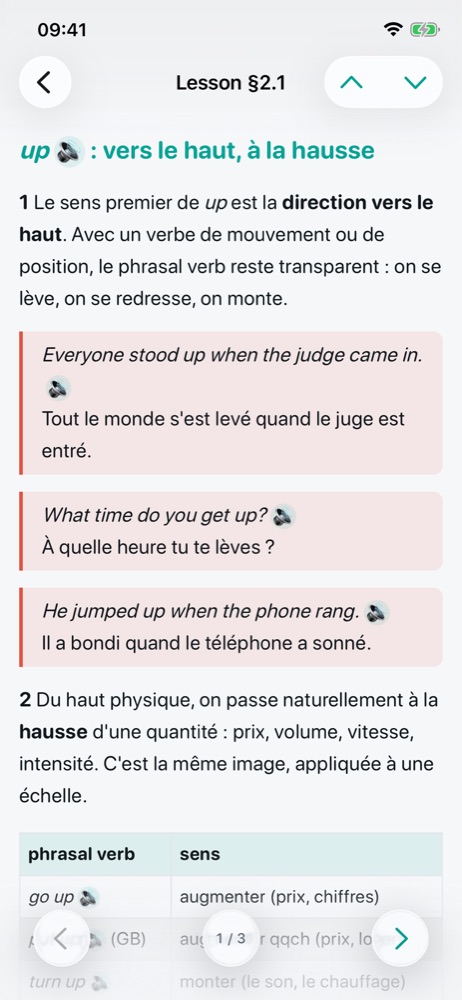
7. Import and fix
- Zip the folder (or rename the archive to
.parrot) and open it in Super Parrot: … menu › Import…. - Analyse shows the preview and any errors. Fix, analyse again, then confirm.
- To enrich the dictionary later, re-import new files as a complement from the dictionary: a new language, a new chapter… Existing objects are found again and your training results are kept.
- For deeper changes, export as CSV 🔒, edit in the spreadsheet and re-import as a complete version.
The column-by-column reference and the finer rules (references, identifiers, updates) are in CSV file reference.